A comparison piece reviewing the different types of charging available for electric vehicles.
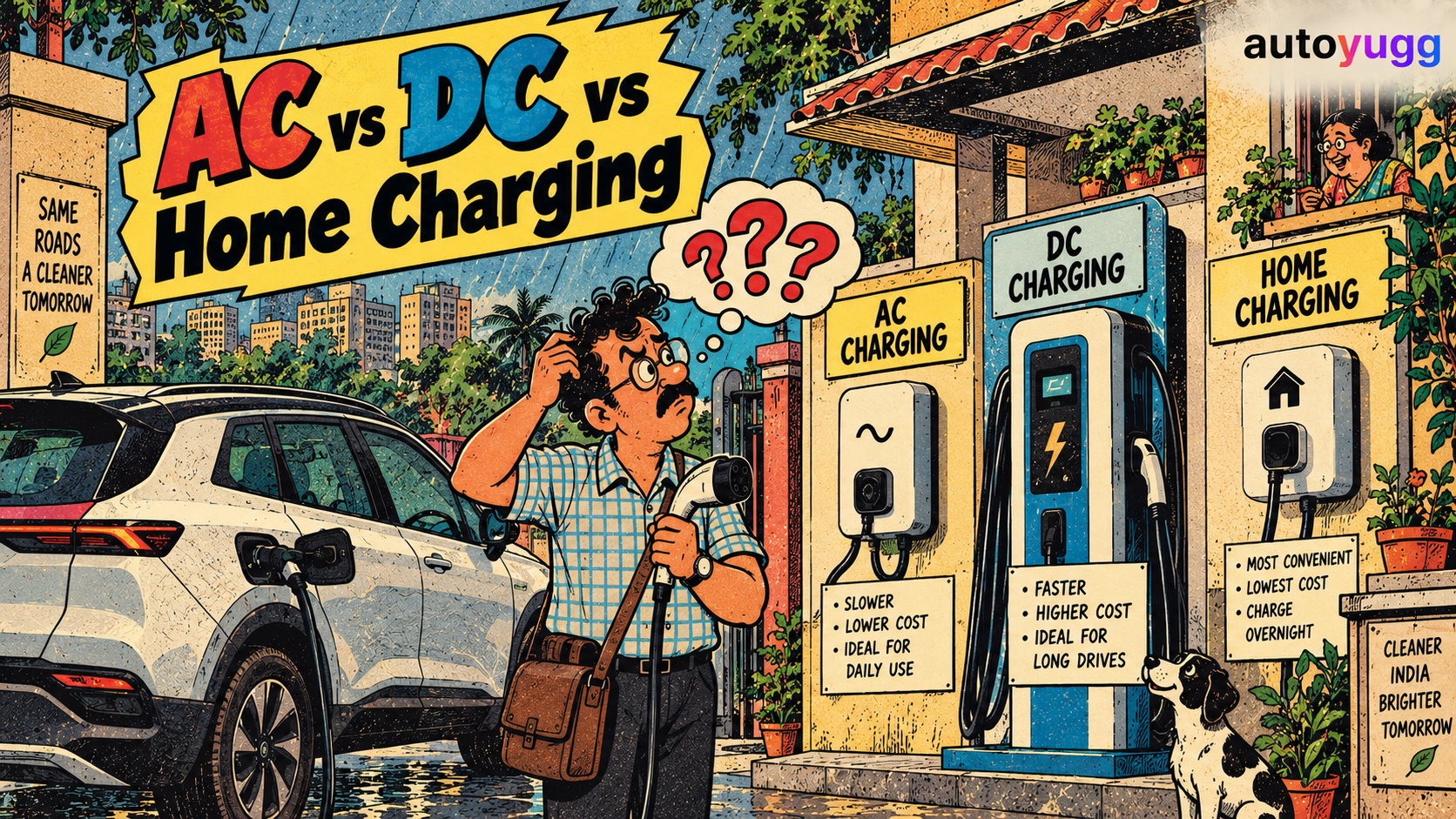
Electric vehicles in India have an additional cost tagging along with their ownership, i.e., charging expenses. While manufacturers may advertise cheap running costs like ₹1.20 per kilometre, that figure is only for residential AC charging using domestic electricity tariffs. If you select commercial public DC fast charging, the expenses can triple or quadruple, pushing the operating cost to ₹3.60 to ₹4.60 per kilometre. We have explained in this piece how each type of charging differs, the tariff structures associated with them and the battery degradation risk involved.
The Technical Architecture: AC vs DC Charging
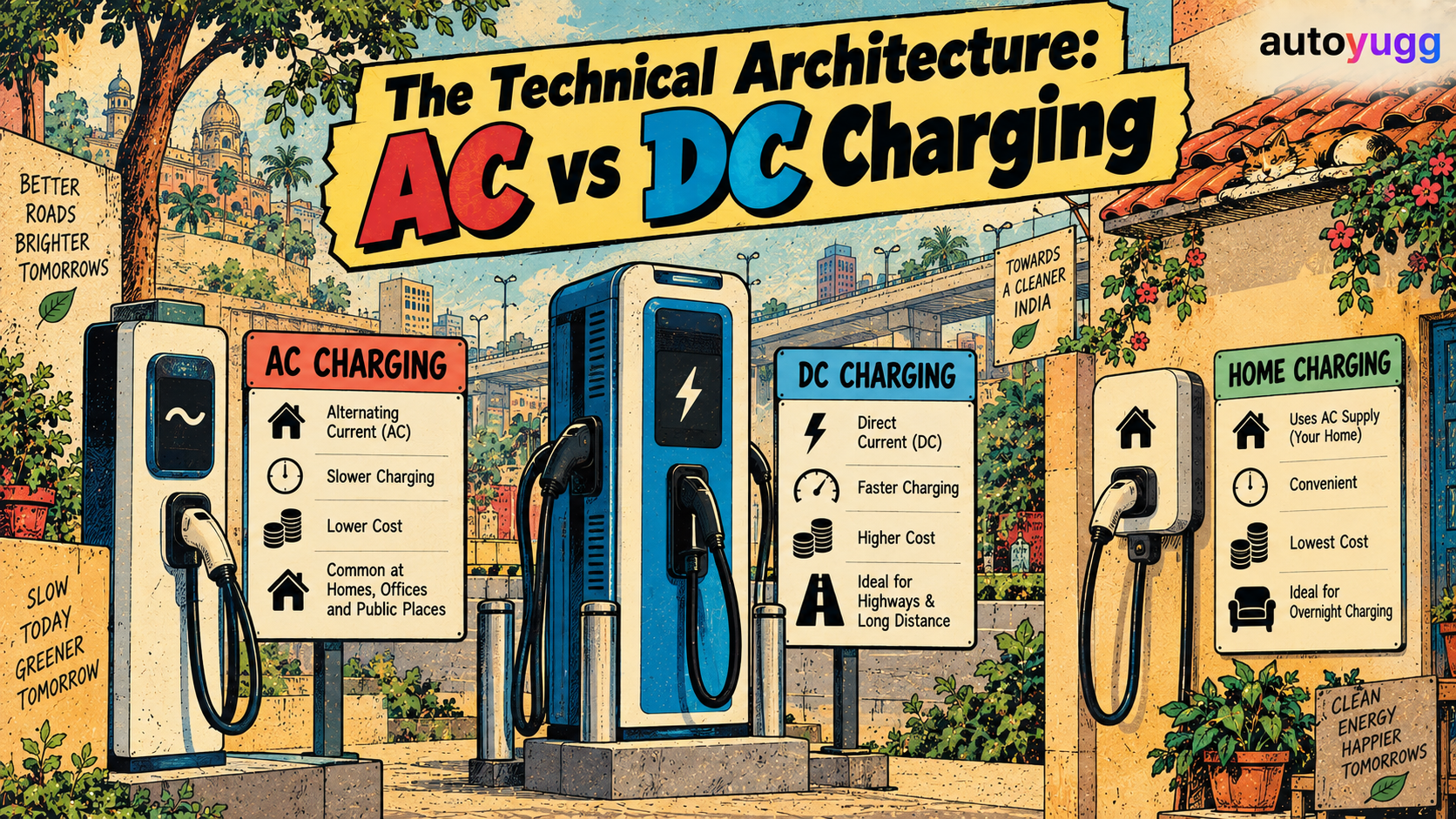
There are usually three levels of charging in India: Level 1 (slow AC charging at home), Level 2 (Fast AC charging in public lots) and Level 3 (DC fast charging in commercial hubs and highways).
| Charging Specifications | Home AC Charging | Public Destination AC Charging | Public DC Fast Charging |
| Power Output Range | 3.3 kW to 7.2 kW (Single-phase) | 7.4 kW to 22 kW (Three-phase) | 30 kW to 175 kW+ |
| AC-to-DC Conversion Point | On-Board Charger (OBC) inside vehicle | On-Board Charger (OBC) inside vehicle | Off-board station inverter cabinet |
| Charging Time (10 to 80%) | 6 to 10 hours | 4 to 7 hours | 30 to 60 minutes (20% to 80% in 20 minutes on newer EV platforms) |
| Grid Current Type Delivered | Alternating Current (AC) | Alternating Current (AC) | Direct Current (DC) |
| Vehicle Hardware Restriction | Restricted by vehicle OBC capacity | Restricted by vehicle OBC capacity | Bypasses vehicle OBC entirely |
| Thermal Management Demand | Low (Ambient air cooling sufficient) | Low to Moderate | High (Active liquid chilling required) |
Note: Because an EV battery stores only direct current, AC charging means the vehicle’s internal On-Board Charger will have to convert the incoming power. Also, Mahindra’s EV platforms offer 11 kW three-phase OBCs for faster AC charging.
When plugging into a standard home wallbox or a public AC post, the charging station is only a safe electrical conduit. The actual conversion from AC to DC takes place within the vehicle’s On-Board Charger (OBC). Most mass-market electric vehicles in India have either a 3.3 kW or 7.2 kW OBC. It means that even if plugged into a 22 kW public AC charger, the EV will only be able to take 7.2 kW.
In comparison, a DC fast-charging station has massive industrial rectifiers inside its outer cabinet. The station converts high-voltage AC from the electrical transformer into DC before the cable reaches the car; it bypasses the vehicle’s compact onboard converter. Simply put, it feeds direct current straight into the battery pack.
But doing this at high power levels can generate a lot of heat in the battery. To keep the process going, the EV has to activate its specialised chillers and liquid pumps. They take away the auxiliary energy from the charging stream to keep the battery within safe temperature thresholds.
Electricity Tariffs, Commercial Markups and Public Station Surcharges
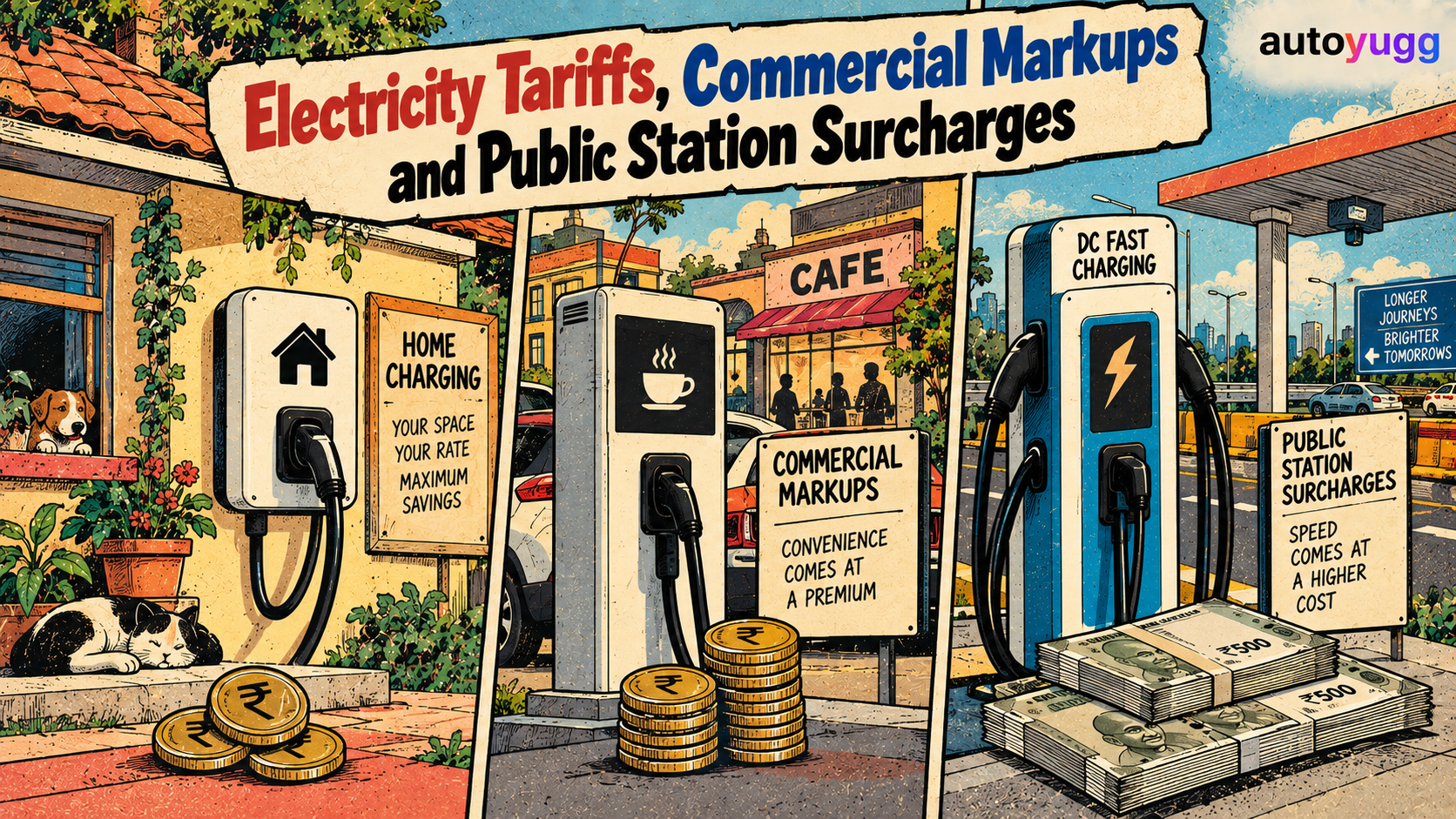
We have laid out a scenario of how much electricity is consumed through different charging methods.
| Charging Method | Average Base Tariff (per kWh) | Taxes and Regulatory Cess | Station Markups and Idle Fees | Effective Rate (per kWh) |
| Residential Home Meter | ₹5.50 to ₹8.50 (Slab-dependent) | 5% to 10% State Electricity Duty | None | ₹6.00 to ₹9.00 |
| Dedicated EV Home Meter | ₹4.50 to ₹6.50 (Time-of-Day) | Flat state utility cess | Fixed meter rental (₹100 to ₹250/mo) | ₹5.00 to ₹7.50 |
| Public Commercial AC Post | ₹10.00 to ₹12.00 | 18% GST on charging service | Minimal parking/session fees | ₹12.00 to ₹15.00 |
| Public DC Fast Charger | ₹16.00 to ₹22.00 | 18% GST on charging service | ₹1.00 to ₹2.00/min idle fee post-charge | ₹19.00 to ₹26.00 |
When a 45 kWh EV is added to a standard household connection, the vehicle’s heavy power draw frequently pushes the entire home’s consumption into the highest billing tier, which means rates of around ₹8.00 to ₹9.00 per unit. To counter this, state DISCOMs such as BSES in Delhi, BESCOM in Karnataka and MSEDCL in Maharashtra offer dedicated single-point EV meters. These meters offer flat, subsidised tariffs of ₹4.50 to ₹6.50 per unit.
At the same time, public charging operators have to deal with high-tension electricity tariffs, expensive transformer installations, demand charges and real estate leasing costs. To recover the expenses and generate profit, they set base rates between ₹16.00 and ₹22.00 per kWh for DC charging. An 18 per cent GST surcharge is then applied to both the electricity consumed and the service fee.
Real-World Running Costs: 45 kWh Battery Case Study
Let’s see how costly it is to charge a hypothetical 45 kWh battery.
| Metric (Based on 45 kWh Pack) | Home AC Wallbox (₹7.50/unit) | Public AC Charger (₹14.00/unit) | Public DC Fast Charger (₹24.00/unit) |
| Energy Drawn to Fill (0 to 100%) | Approx. 51.0 kWh (88% OBC efficiency) | Approx. 51.0 kWh (88% OBC efficiency) | Approx. 48.0 kWh (93% direct efficiency) |
| Cost for a Full Charge | ₹382.50 | ₹714.00 | ₹1,152.00 |
| Real-World Usable Range | 320 km | 320 km | 320 km |
| Effective Cost Per Kilometre | ₹1.20 | ₹2.23 | ₹3.60 |
| Monthly Expense (1,250 km/mo) | ₹1,500 | ₹2,788 | ₹4,500 |
| Annual Cost (15,000 km/yr) | ₹18,000 | ₹33,450 | ₹54,000 |
Note: Over an annual driving distance of 15,000 kilometres, if you charge your EV at home, you can save ₹36,000 compared to relying entirely on public DC fast chargers.
The AC-to-DC conversion conducted by a car’s onboard charger works at roughly 85 to 88 per cent OBC efficiency. Consequently, delivering 45 kWh of energy into a 45 kWh pack means drawing approximately 51 kWh of electricity from the residential meter. At an average domestic rate of ₹7.50 per unit, a complete fill costs roughly ₹382.50.
However, at a commercial rate of ₹24.00 per unit (including GST), that single charging session costs ₹1,152.00 at a public DC fast charger. The cost per kilometre jumps to ₹3.60. You save time, but you have to spend more money.
Long-Term Battery Health and Residual Value
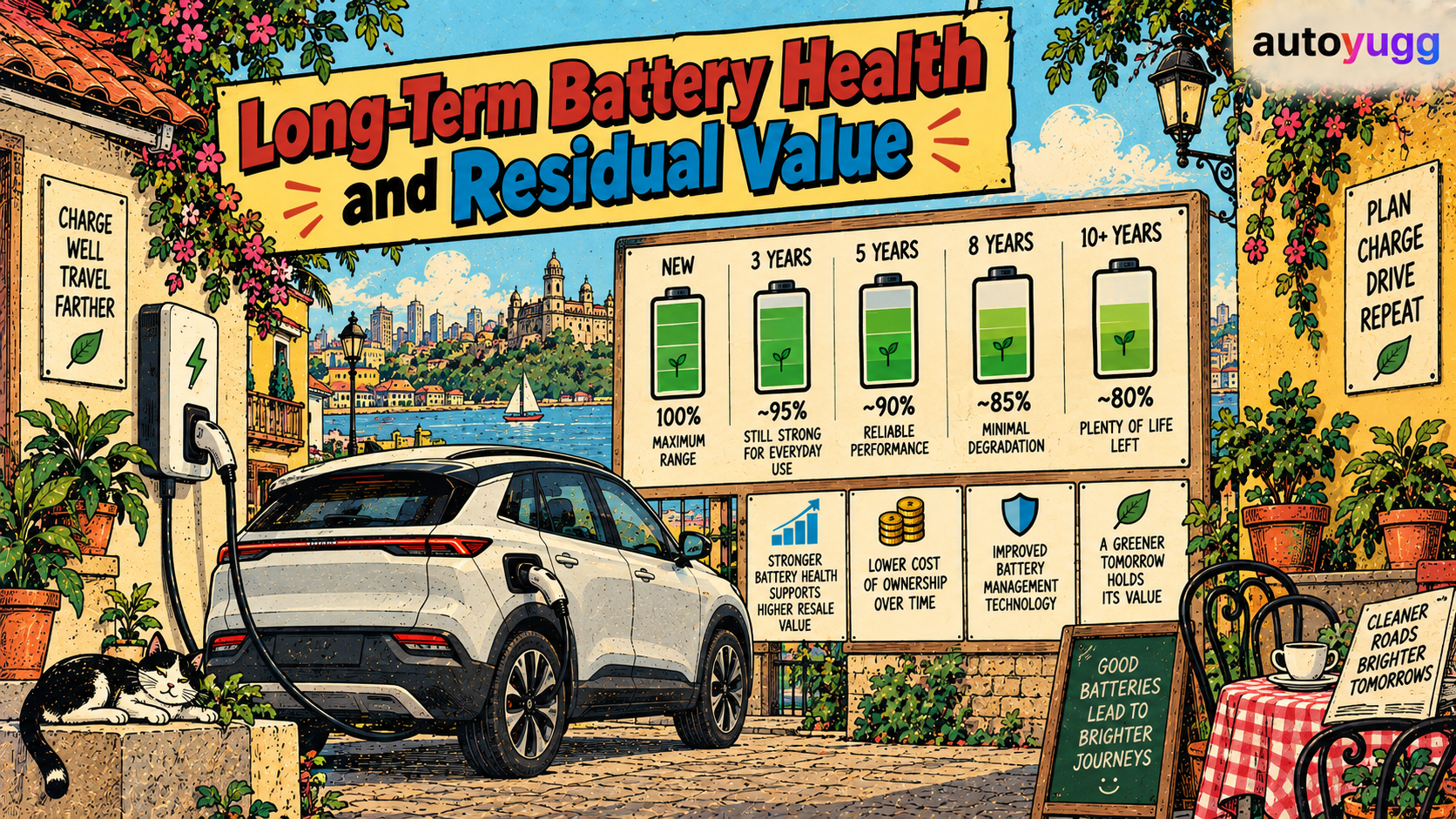
Beyond direct electricity expenses, charging methods affect battery longevity as well. DC fast chargers pump energy into the pack at continuous rates of 0.8C to 1.5C (where 1C equals charging the entire battery capacity in one hour). This high-current transfer causes a lot of heating and mechanical stress inside the battery, which can lead to premature capacity loss.
Home AC charging operates at low C-rates of 0.1C to 0.15C. It allows lithium ions to move smoothly into the graphite anodes without creating any thermal stress. By doing so, it preserves battery health and protects the vehicle’s driving range and resale value.
AutoYugg Verdict: Which Charging Method Is Better?
Home AC charging can be considered the better choice for both financial savings and long-term battery health. For daily urban commuters who have dedicated parking and home charging access, an EV can offer actual ₹1.20 per kilometre mobility.
Public DC fast charging, in contrast, should be thought of more as a strategic tool rather than a daily refuelling habit. You can use it when you want to stay free of range anxiety during long-distance highway travel by restoring 200 kilometres of driving range in 30 to 40 minutes. But remember that this method of charging increases annual fuel bills by around 200 per cent. It also puts extra thermal stress on the battery pack.