A pre-drive checklist covering your car’s mechanical health, tyre safety and emergency gear so that your highway journey remains smooth and trouble-free.

While modern cars can conveniently handle thousands of kilometres with little to no fuss, maintaining high speeds and temperatures all day long on a road trip can quickly expose neglected wear and tear. And nothing ruins the trip faster than the smell of an overheating engine or a sudden puncture on an unlit highway.
Key Takeaways
- Always check tyre pressures when the rubber is completely cold.
- Top up essential engine fluids, from coolants to windscreen washer liquids.
- Always check if your FASTag KYC status is active or not to prevent toll plaza delays.
To make every pre-trip inspection of your car simple, we have listed some essential things to check before packing your luggage and hitting the open road. Spending forty-five minutes on these before turning the ignition key can save you hours of waiting for a flatbed tow truck on a remote highway.
Tyres: Cold Pressure, Tread Wear and the Spare Wheel
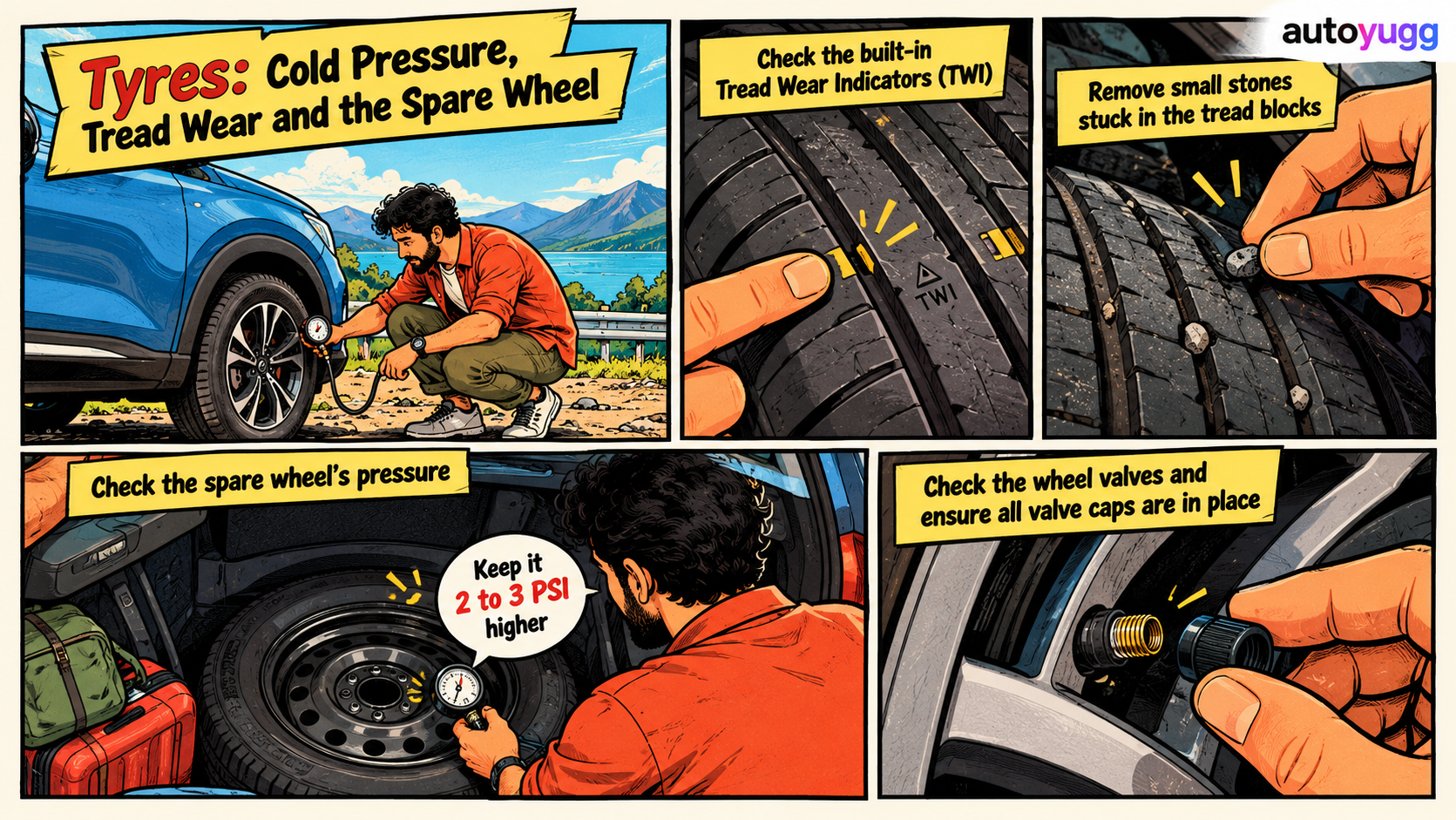
Your tyres are your primary safety line at 100 kmph. As tyres spin at high speeds, internal friction generates a lot of heat, causing air to expand. If your tyres are under-inflated, the sidewalls flex more than usual, leading to rapid heat buildup and even potential high-speed tyre delamination.
Check your cold tyre pressures before taking the car out. Follow the PSI ratings on the sticker inside the driver’s door. Run your fingers through the outer and inner sidewalls to find out if there are any bulges, deep cuts or stuck nails.
- Check the built-in Tread Wear Indicators (TWI), the ones inside the main grooves. If the tread surface wears down flush with these bars, tyre depth has hit the 1.6 mm limit. It needs replacement.
- Clear out small stones stuck between the tread blocks. They can cause punctures over concrete highway joints.
- Open the boot, lift the floor panel and check the spare wheel’s pressure. It should be 2 to 3 PSI higher than normal, as spare tyres lose air slowly over months of disuse.
- Take a look at the wheel valves as well. Make sure that all valve caps are tight so that fine road dust cannot enter the inner pin.
Under the Bonnet: Refill Vital Engine Fluids

Continuous highway driving will keep your engine between 2,000 and 3,500 rpm for hours. It places high demands on lubrication and cooling systems. And if your car is low on fluid levels, a small traffic holdup on a flyover can become a potential breakdown.
Park your car on level ground and let the engine cool down completely before opening the bonnet. Pull out the engine oil dipstick, wipe it clean with a rag, insert it fully and pull it out again. The oil level must sit between the ‘Min’ and ‘Max’ markers. And if the oil appears thick, pitch black or gritty, then it’s time for an oil and filter change.
- Check the coolant overflow tank; the plastic reservoir should show the fluid sitting between the minimum and maximum lines.
- Check the brake fluid reservoir near the firewall; it should be clear amber, not dark brown or cloudy.
- Fill the windscreen washer tank to the brim with clean water mixed with a bug-remover washing fluid to get rid of dried insect splatter.
- Check the rubber hoses connected to the radiator. Squeeze them gently. They should feel firm and pliable, not brittle, cracked or mushy.
Braking System: Check Pad Thickness and Pedal Bite
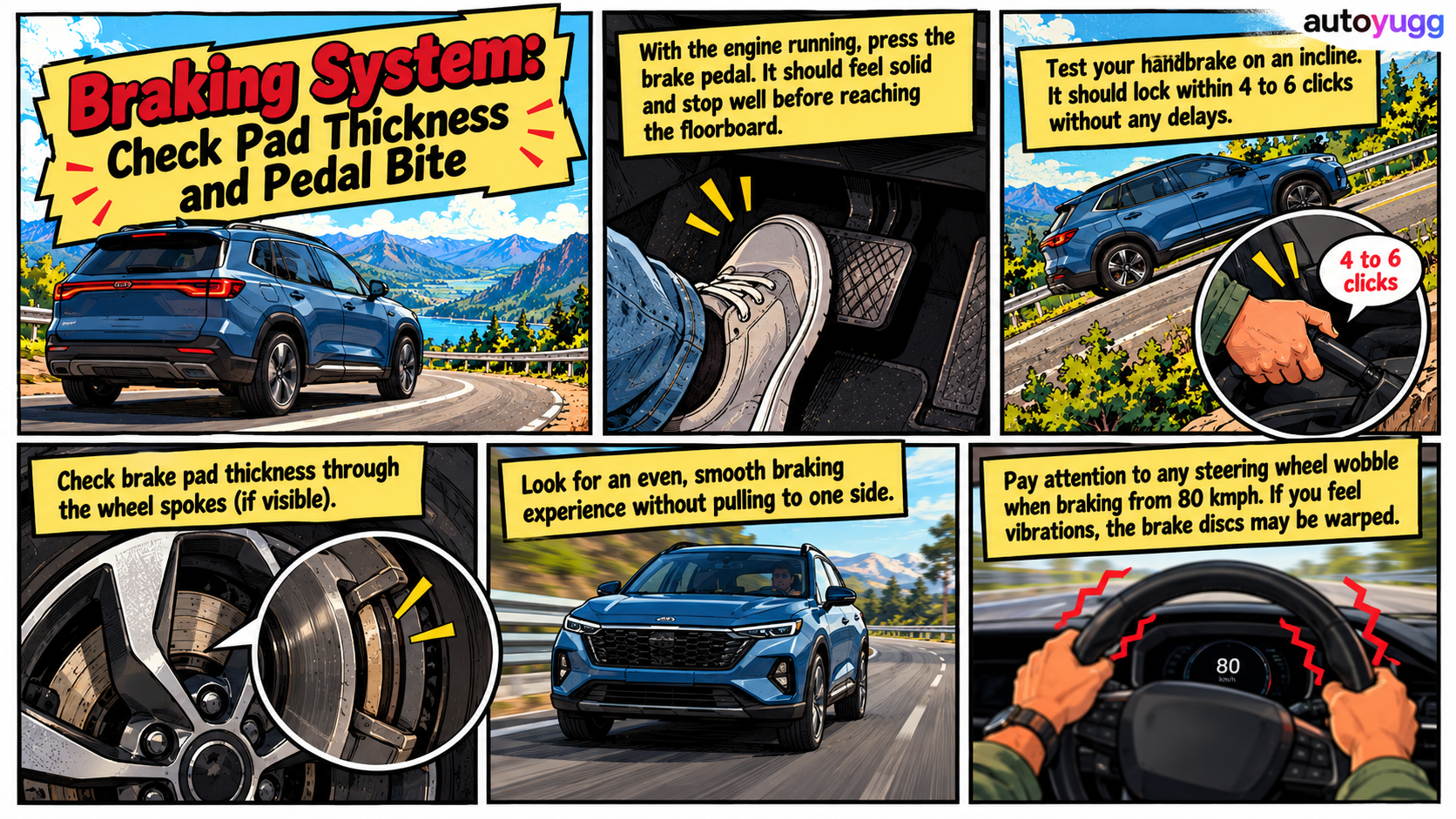
Highway speeds also need immediate, predictable stopping power on standby at all times. A spongy brake pedal or metal-on-metal grinding noises are some indicators that your braking hardware needs immediate attention.
Look through the spokes of your alloy wheels with a torch to inspect the brake pads. The friction material pressed against the metal rotor should measure at least 4 mm in thickness. If the pads look paper-thin, replace them immediately.
- Keep the vehicle still and press the brake pedal with the engine running. It should feel solid and stop well before reaching the floorboard.
- Test your handbrake on an incline as well. The lever should be able to lock within 4 to 6 clicks without any hiccups or delays.
- Pay attention to any steering wheel wobble when you’re braking from 80 kmph. If vibrations are felt, it means that the brake discs have been warped from excessive use and heat.
Battery and Electricals: Health and Lighting

An overnight stay in a cold hill station can sometimes completely drain the remaining charge of your car’s battery. And on unlit rural roads, you always have to stay ready with fully functioning lights for night trips.
To prevent any issues, first do a thorough inspection of the 12V battery’s terminals under the bonnet. Is there a white or bluish crust forming around the terminals? Pour warm water over them and scrub clean with a small brush to keep electrical contact clean. Moreover, if your car hesitates for even a split second during morning cold starts, get the battery’s health quickly tested at an auto shop.
- Turn on all lights and walk around the vehicle: check whether the high beams, low beams, fog lamps, indicators and reversing lights are working or not.
- Have a family member press the brake pedal while you check that both rear brake lights and the high-mounted stop lamp illuminate brightly.
- Your 12V charging socket and interior USB ports must also be giving steady power to keep smartphones running.
Wiper Blades and Air Conditioning
During monsoon downpours, you need a lot of clear forward visibility as well. But old, unclean wiper blades can leave oily streaks across the glass, which may scatter the glare from oncoming high beams and blind you at night.
Lift the wiper arms and run your thumb along the rubber edge. If the rubber feels hard, cracked or leaves water lines during a test wipe, then you need a fresh pair of blades. Also, inside the cabin, turn your air conditioning up. If the airflow smells musty or takes several minutes to cool down the front seats, pull out the cabin pollen filter behind the glovebox and blow out any built-up dust or stuck leaves.
Other Factors: Emergency Kit, FASTag and All Digital Documentation

Staying physically prepared for an unexpected breakdown is as important as checking everything before the road trip. Your boot should at least have a working screw jack, a wheel wrench, a reflective warning triangle and a basic first-aid pouch with fresh antiseptic liquid.
A 12V portable tyre inflator that plugs into your cigarette lighter is also an invaluable tool. You can top up a slow-leaking tyre and reach a tyre shop safely without getting your clothes dirty while changing wheels on a highway.
- Check your FASTag status through your banking app to confirm your KYC is fully updated and active. Also, under NHAI guidelines, passenger cars only need a valid, non-negative balance sufficient for the plaza fee, but carrying a reasonable recharge buffer will keep any delays out of sight.
- Download offline maps for your entire travel route on Google Maps because you may not get mobile network in remote areas.
- Keep digital copies of your driving licence (DL), registration certificate (RC), valid insurance policy and Pollution Under Control (PUC) certificate ready on the DigiLocker or mParivahan app.
Pre-Trip Quick Inspection Checklist
To summarise, here’s everything you need to do before beginning your journey.
| Component | What to Inspect | Healthy Condition | What to Do if Faulty |
| Tyres & Spare | Cold pressure and tread depth | Minimum 1.6 mm tread; correct door-jamb PSI | Inflate cold; replace worn tyres |
| Engine Oil | Level and oil colour on dipstick | Amber or golden brown; between Min and Max | Top up correct grade or change oil |
| Engine Coolant | Level in plastic overflow tank | Level resting between Min and Max marks | Top up with 50:50 premixed coolant |
| Brake Pads | Friction material thickness | More than 4 mm visible pad thickness | Replace pads at authorised workshop |
| 12V Battery | Terminal crust and cranking speed | Clean terminals; quick, instant engine start | Clean white deposits and test voltage |
| All Lights | Headlamps, indicators, brake lights | All bulbs and LED strips lighting brightly | Replace fused bulbs before nightfall |
| Wiper Blades | Rubber blade edge flexibility | Smooth, clean wipe without chatter or lines | Install fresh frameless wiper blades |
| Emergency Gear | Jack, wrench, hazard triangle, inflator | Complete toolkit present in the boot floor | Procure missing tools and test tyre pump |
Conclusion

Taking 45 minutes to check all the things we have mentioned will make your highway journeys smooth and relaxed road trips. And when your tyres are healthy, your engine fluids are fresh, and your emergency kit is ready in the boot, you can focus on enjoying the open road ahead with complete peace of mind.