Harrier EV
Book free test drive.
Tata Harrier EV · Pickup at home or visit your nearest verified dealer · No obligation.
Tata Harrier EV key specifications.
Notable features that put the Tata Harrier EV above its segment.
Configure your Tata Harrier EV.
5 variants available. Select a variant to view full specs and pricing.
Tata Harrier EV expert review.
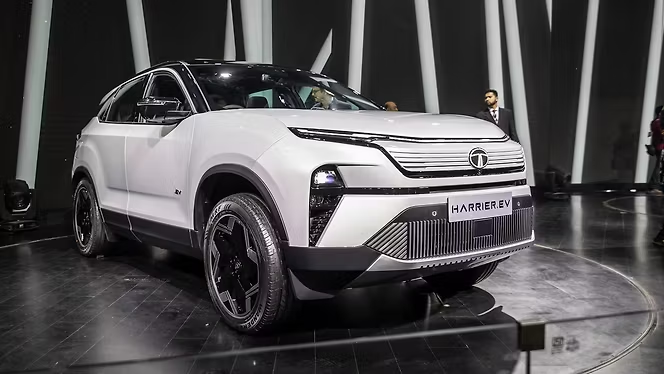
What is the Tata Harrier.ev?
Tata has been the highest seller of passenger electric vehicles in the Indian market. One way it has achieved that is by offering EV variants of its internal combustion engine (ICE) cars and SUVs. Building on the momentum of the Nexon.ev and Punch.ev, Tata is now targeting the premium, eco-conscious urban segment with the Harrier.ev. Oh, and it also shields owners from escalating fuel prices.
Who Should Buy the Tata Harrier.ev?
Tata has positioned the Harrier.ev as a lifestyle family tourer and, given the 75kWh battery pack, the Harrier.ev is targeted at the same audience. Daily office commutes should not be a problem and taking the family — wife and kids — out for a small trip is something the Harrier.ev can do with ease.
If you are looking for a weekend getaway to a remote area where the terrain is rough, the electric off-roader handles rough terrain comfortably.. Add to this a real-world range of 400km–500km on Indian roads and you can rest assured this can serve as your primary vehicle for both work and leisure without investing in another ICE vehicle.
How Practical Are the Tata Harrier.ev Interiors?
Being the tallest vehicle in its segment at 1740mm and measuring 4670mm in length, the interior space is generous. There is enough headroom and shoulder room at the front, while three passengers can comfortably sit in the back seat.
Where things get a bit awkward is the higher floorboard. Like all EVs, the battery pack is placed under the passenger compartment, raising the floor height. This, combined with the lack of under-thigh support, can cause fatigue during long drives, especially if you are six feet tall or taller.
Up front, taller individuals may find it necessary to lower the seat to its lowest position to prevent their left knee from touching the dashboard. This elevated floor architecture also impacts cargo packaging at the rear, where the electric motor is situated. While the 502-litre boot capacity remains respectable, the increased loading lip and shallow floor — due to the space-saver tyre tucked underneath — can make loading heavy luggage slightly cumbersome.
Overall seating comfort is not a problem, but you will have to keep these quirks in mind when buying the Harrier.ev. None of them are deal breakers, though they do take some time getting used to.
How Good Is the Tata Harrier.ev Infotainment?
Tata has partnered with Harman for the UI design and this makes interaction with the infotainment system much simpler than what we have experienced with some rival systems in this segment. The 14.53-inch Samsung Neo QLED infotainment screen is sharp and responsive. Combine the well-thought-out user interface with the bright QLED display and you will have no trouble viewing the screen even during harsh summer afternoons.
As expected, the system supports wireless Android Auto and Apple CarPlay.
Other advanced features include Auto Park Assist, Summon Mode, a 360-degree surround-view camera and an underbody camera view, all of which make manoeuvring the Harrier.ev in city traffic, steep inclines or rocky terrain significantly easier.
Tata Harrier.ev Battery & Range
The 75kWh Lithium Ferrous Phosphate (LFP) battery pack powers the Harrier.ev. This battery pack is designed for efficiency, which contributes to the overall range of the vehicle. It is not a simple plug-and-play transition from the ICE Harrier to the EV. The battery is integrated into Tata’s electric architecture and designed around weight distribution, cabin packaging and high-speed stability.
Tata offers high-speed charging with support for up to a 120kW DC fast charger. This is not segment-leading, as the Mahindra XEV 9e can charge from 20-80 percent in just 20 minutes using a 180kW DC fast charger. Though the Harrier.ev may not match the XEV 9e’s charging speed, it can still add around 250km of range in just 15 minutes on a 120kW charger. This makes highway trips and intercity travel significantly less stressful.
The Harrier.ev is expected to deliver around 420–500km of real-world range depending on driving style and terrain. City driving with regenerative braking should maximise efficiency and help achieve figures close to the upper end of that range, while sustained highway speeds and off-road driving will bring the range closer to the 400km mark. Considering its size and dual-motor setup.
Is the Tata Harrier.ev Fun to Drive On-Road?
To answer that question, let’s first look at the numbers. The Harrier.ev 75kWh comes with a dual-motor setup, with the front motor producing 159PS and the rear motor producing 238PS. Combined power output stands at 396PS, while 504Nm of torque helps move this 2.3-tonne vehicle forward with serious urgency.
There are four drive modes to choose from depending on your mood and road conditions ahead — Eco, City, Sport and Boost mode.
Boost Mode
I was quite eager to see how the power is delivered and for that we activated Boost Mode. The Harrier.ev surged forward in a surreal manner. There is no engine noise, no drama and no delay — just an instant wall of torque that completely changes your perception of how quickly a family car can move.
We did not use timing equipment, but Tata claims the dual-motor all-wheel-drive Harrier.ev can sprint from 0-100km/h in 6.3 seconds and that figure feels entirely believable.
What makes this performance even more impressive is how calm and composed the Harrier.ev remains while reaching triple-digit speeds. Yes, the traction control lights flash on the screen and the tyres squeal as the rear wheels dig into the tarmac, but at no point did the SUV feel intimidating or unpredictable.
Braking performance is strong enough to slow the 2.3-tonne EV quickly, though it is not quite as confidence inspiring as I would have liked.
Still, Boost Mode showcases Tata’s engineering capabilities brilliantly, even if most owners are unlikely to use it regularly.
A word of caution though — if you ever use this mode, avoid trying it in traffic as things can get out of hand very quickly.
Sport Mode
As the name suggests, the Harrier.ev feels quick and agile in Sport Mode. Throttle response sharpens considerably and there is always enough power in reserve for quick overtaking manoeuvres on the highway.
The chassis feels composed and stable even while carrying triple-digit speeds through long corners. The low centre of gravity, thanks to the battery pack mounted beneath the passenger compartment, helps keep body roll in check.
The frequency-dependent damping system automatically stiffens the suspension during spirited driving while softening it over rough roads and broken surfaces.
Though I thoroughly enjoyed Sport Mode, the quicker battery drain meant my fun was short-lived. With home still 200km away, better sense prevailed and I eventually switched to City Mode.
City Mode
After the aggression of Boost and Sport Mode, City Mode came as a surprise. The Harrier.ev undergoes a complete transformation here. From a raging bull, it becomes a calm and comfortable family SUV capable of carrying five passengers and luggage over long distances with ease.
One concern I initially had was whether City Mode might feel too tame to be enjoyable. Thankfully, that is not the case. Power delivery remains smooth and effortless, while the SUV never feels lacking in performance during daily driving.
Quick overtakes are still easy and stop-and-go traffic is handled calmly. The steering also becomes lighter, making city driving significantly easier.
City Mode ultimately impressed me with its versatility, whether during highway cruising or navigating tight urban roads.
Eco Mode
If City Mode feels calm, Eco Mode takes things a step further. Though I may not personally prefer driving in this mode every day, I can understand why chauffeur-driven owners may appreciate it.
More importantly, Eco Mode maximises efficiency and can stretch the range closer to the 500km mark. The suspension softens noticeably, helping the SUV glide over potholes and poorly designed speed breakers around the city.
Like City Mode, the steering remains light, which is especially helpful considering the Harrier.ev’s 5.75-metre turning radius.
For owners looking to venture off-road, Tata also offers six Terrain Response Modes including Normal, Rock Crawl, Mud Ruts, Snow/Grass, Sand and a Custom Mode that allows drivers to personalise settings.
Tata Harrier.ev Safety & ADAS Features
Safety has always been a strong point for Tata products and the Harrier.ev is no different. The SUV has secured a 5-star Bharat NCAP safety rating with scores of 32/32 for adult occupant protection and 45/49 for child occupant protection.
There are seven airbags on higher variants, including front, side, curtain and knee airbags.
Front and rear parking sensors, Auto Park Assist, Reverse Assist and Summon Mode help make parking in tight spaces easier. Other useful features include a Blind Spot View Monitor, which is especially important given how long and wide the SUV is.
The underbody camera is particularly useful as it provides a transparent underbody view while tackling steep inclines, descents and rough off-road terrain.
Should You Buy the Tata Harrier.ev?
The Tata Harrier.ev feels like Tata Motors’ most complete electric vehicle yet. It combines strong real-world range, impressive performance and everyday practicality into a package that feels easy to live with. What stands out most is its versatility. In one moment it can quietly cruise through city traffic like a comfortable family tourer and in the next it can launch forward with surprising urgency.
Yes, there are compromises. Taller passengers may notice the raised floor and charging speeds still trail some born-electric rivals. But none of these issues are significant enough to take away from the overall experience.
For buyers looking to move to an electric vehicle without sacrificing space, comfort or long-distance usability, the Harrier.ev makes a very strong case for itself.
Tata Harrier EV user reviews.
No reviews yet for Harrier EV.
Be among the first to share your experience with the Harrier EV. Your honest review helps thousands of buyers make the right choice.
Tata Harrier EV on-road price in your city.
Final price varies by RTO, dealer, insurance choice, and state-specific charges. Select your variant and city for the full breakdown.
Tata Harrier EV on-road price across India.
Loading city prices…
On-road price = Ex-showroom + RTO + Insurance + Other charges.
Tata Harrier EV brochures.
Get the official Tata Harrier EV brochure — full specifications, color options, variant details, and pricing in one document.
What's new with Harrier EV.
Recent price changes, launches, awards, and news.
Deliveries of the Tata Harrier EV have officially begun in India on 31st July 2025.
Not sure if Harrier EV is the right pick?
Tell us your priorities — body type, budget, seating, fuel preference — and we'll match you with the best options across all brands. No spam, no signup. Real recommendations in 3 minutes.
Helpful tools for your buying decision.
From EMI to fuel cost — make informed choices before you buy your next car.
EMI Calculator
Plan your monthly outflow by loan amount, tenure & rate.
Open calculator →Fuel Cost Calculator
Estimate monthly fuel spend based on your driving pattern.
Open calculator →On-Road Price
Get exact ex-showroom + RTO + insurance for your city.
Go to tool →Compare Cars
Side-by-side specs, features & ownership cost.
Go to tool → NewEV vs Petrol Savings
Calculate lifetime fuel savings if you switch to electric.
Open calculator →Resale Value
Predicted resale value after 3, 5 or 7 years of ownership.
Open calculator →